How Many Pieces of Art Do You Need for an Exhibition?
 Sep, 7 2026
Exhibition Inventory Calculator
Estimate how many pieces you need by balancing physical space constraints with narrative requirements.
Enter details to calculate your exhibition inventory.
Curatorial Advice
You’ve spent months in the studio. The paint is dry, the sculptures are cured, and you’re staring at a pile of work that feels both endless and insufficient. Then the email arrives: "We’d love to host your show." Panic sets in. How many pieces do you actually need? Is it ten? Fifty? A hundred?
Here’s the truth: there is no magic number. But there is a right number for your specific exhibition. Getting this wrong can make a small gallery feel cluttered or a large hall feel empty. It affects how people move through the space, how long they stay, and ultimately, whether they buy anything. Let’s break down exactly how to calculate your inventory needs based on real-world constraints, not just guesswork.
The Space Dictates the Count
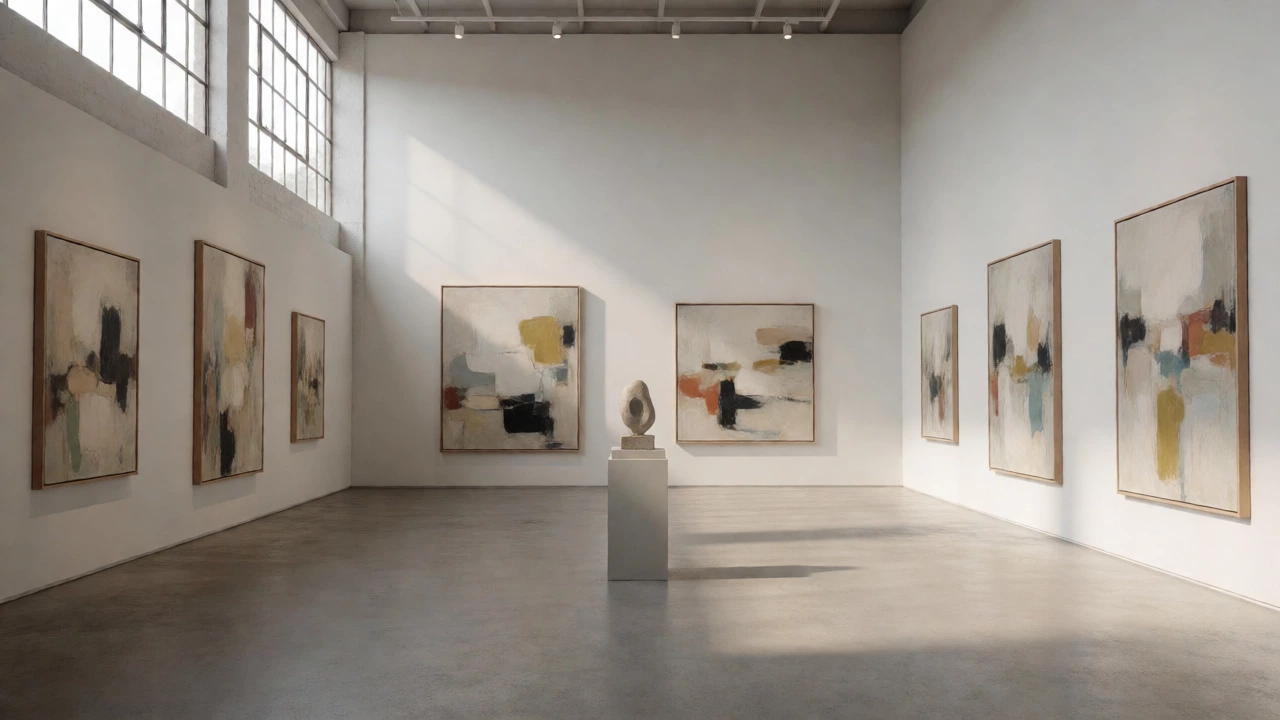
Before you count a single canvas, look at the floor plan. The physical dimensions of the venue are the primary constraint. A cramped pop-up shop in a coffee store cannot hold the same volume as a warehouse-style gallery in Chelsea.
Curators often use a rule of thumb called "breathing room." If you hang works too close together, viewers’ eyes get tired, and individual pieces lose impact. For wall-based art like paintings or photography, aim for at least 12 to 18 inches of clear wall space between frames. For smaller items like prints or jewelry, you might reduce this to 6 inches, but never less.
Consider the viewing height. Most galleries hang art so the center line is at eye level, typically around 57 to 60 inches from the floor. In a standard 10-foot ceiling room, you have roughly two rows of hanging space if you go floor-to-ceiling, but usually only one strong row is effective. Calculate your linear wall footage. If you have 100 feet of usable wall space and each piece plus its buffer takes up 4 feet, you can fit about 25 wall-mounted works. Add floor space for sculptures, which need even more clearance-often a radius equal to the object's largest dimension.
Type of Art Changes Everything
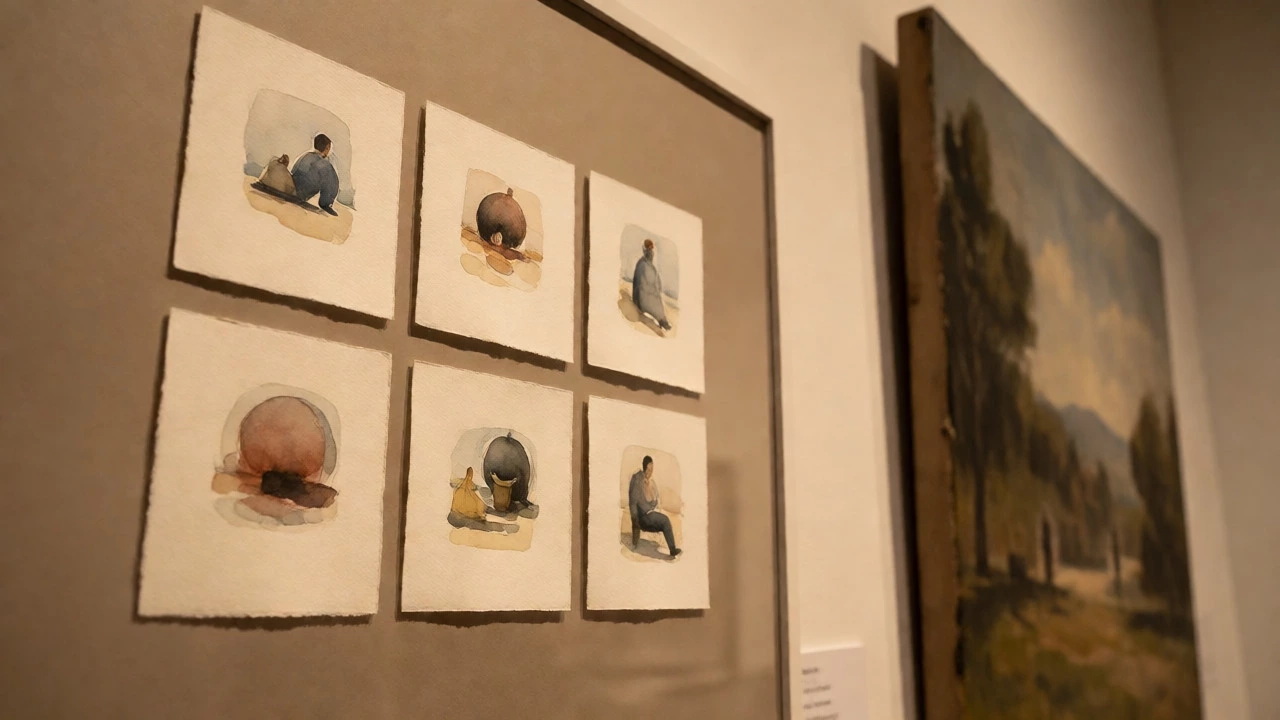
A collection of 50 tiny watercolors behaves differently than five massive abstract canvases. Scale matters. Small works require grouping to create visual weight. If you display a series of 3-inch sketches individually, the wall will look sparse and disjointed. Instead, group them into clusters of four or six within a larger frame or on a grid system. This counts as one "visual unit" for spacing purposes, even though it contains multiple pieces.
| Artwork Type | Typical Size | Spacing Rule | Estimated Count (Small Gallery) |
|---|---|---|---|
| Large Paintings | 4ft x 6ft+ | 2-3 ft gap between edges | 10-15 pieces |
| Medium Works | 2ft x 3ft | 1-2 ft gap between edges | 20-30 pieces |
| Small Prints/Drawings | Under 1ft x 1ft | Grouped in clusters | 40-60 pieces (in groups) |
| Sculpture | Variable | Radius of object + 2ft | 5-10 pieces |
If you are working with mixed media, such as video installations or interactive digital art, the count drops significantly. These pieces demand time. Viewers need minutes, not seconds, to engage. A single compelling video installation might hold attention longer than five static paintings combined. In these cases, fewer works allow for deeper immersion.
Narrative Arc Requires Volume
An exhibition is not just a storage solution; it’s a story. To tell a coherent narrative, you need enough material to establish a beginning, middle, and end. Think of your show as a book. One chapter isn’t a novel; it’s a pamphlet.
Most successful solo shows follow a thematic progression. Maybe you start with early experiments, move into the core technique, and end with recent breakthroughs. If you only have three pieces per theme, the transition feels abrupt. Aim for at least three to five distinct "moments" or sub-themes within your show. Each moment should be supported by a cluster of related works. If you have three themes and need five works per theme to establish the idea, you’re looking at a minimum of fifteen pieces, plus outliers or transitional works.
Ask yourself: Can I prove my point with what I have? If you claim to explore "light and shadow," but only show two high-contrast photos, the argument feels weak. Repetition builds credibility. Seeing a concept explored across different angles, sizes, and materials convinces the viewer of your mastery.
Budget and Production Realities
Let’s talk money. Framing, crating, shipping, and insurance costs scale directly with quantity. Ten large framed oils cost exponentially more to transport than ten unframed prints. If you are self-funding, every additional piece eats into your marketing budget or profit margin.
Also consider production time. If you need forty new works for a show three months away, can you physically produce them without sacrificing quality? Rushing leads to burnout and mediocre results. Sometimes, showing twenty polished pieces beats fifty rushed ones. Galleries prefer consistency over volume. A cohesive body of work looks professional; a disparate pile looks like a garage sale.
Check your contract. Some venues charge per square foot or take a higher commission if you exceed a certain number of works due to increased handling labor. Clarify this before you commit to a number.
Viewer Attention Span Limits
Data from museum studies suggests the average visitor spends between 15 and 30 minutes in a small commercial gallery. They don’t view every piece equally. They scan, stop at hooks, skim the rest, and leave. If you overload the space, visitors experience "museum fatigue." Their brains shut down after processing too much visual information quickly.
Optimal engagement happens when a viewer can comfortably spend 30-60 seconds per significant work. If you have 40 pieces, that’s 20-40 minutes of pure viewing time, plus walking time. That fits perfectly within the typical visit window. If you have 100 pieces, visitors either rush through everything superficially or skip half the show entirely. They might miss your best work because they got tired halfway in.
Test this. Invite friends to walk through a mock setup. Watch where they stop. Did they linger? Or did they breeze past? Adjust your count based on their energy levels, not your ego.
Practical Checklist for Finalizing Your Count
Use this step-by-step process to lock in your numbers:
- Measure the Venue: Get exact linear footage of walls and square footage of floor space. Subtract areas blocked by doors, windows, or fire exits.
- Categorize Your Inventory: Sort works by size and type. Group small items that must be displayed together.
- Apply Spacing Rules: Use the 12-18 inch wall buffer rule. Create a digital layout using software like SketchUp or even paper cutouts on a floor plan.
- Define the Narrative: Identify your 3-5 key themes. Ensure each has sufficient support (min. 3-5 works).
- Run the Fatigue Test: Simulate the walkthrough. Does it feel dense or airy? Trim the weakest links first.
- Confirm Logistics: Check framing budgets and shipping limits against your final count.
Remember, it’s better to under-show than over-show. You can always add a few pieces if the space feels too empty during install day. Removing works mid-show looks disorganized and desperate. Start lean, then expand if needed.
Common Pitfalls to Avoid
Don’t fall into the trap of "more is better." Artists often think showing more work proves productivity. Curators think showing more work proves lack of editing skills. Be ruthless. If a piece doesn’t serve the central theme, cut it, even if it’s pretty. It dilutes the message.
Another mistake is ignoring vertical space. Don’t stack art floor-to-ceiling unless it’s a deliberate stylistic choice, like a salon hang. Standard eye-level placement is safer for sales. People buy what they can easily see and connect with emotionally.
Finally, don’t forget the exit. Leave space near the door for a catalog table or a statement panel. Crowding the entrance confuses traffic flow. Visitors need a place to pause, read, and orient themselves before diving into the art.
Is there a minimum number of artworks required for a solo show?
While there is no universal legal minimum, most reputable galleries expect at least 10-15 substantial works for a solo exhibition. Fewer than 10 often feels like a display rather than a curated show. However, if the works are large-scale installations, 5-7 major pieces may suffice if they occupy significant space and offer deep conceptual value.
How does the price of artwork affect the number of pieces shown?
Price influences density indirectly. High-priced works often benefit from isolation to emphasize their value and uniqueness. Lower-priced items, like prints or ceramics, are often grouped to encourage impulse buys and create a sense of abundance. A show of $5,000 paintings might have fewer pieces spaced widely compared to a show of $200 prints clustered together.
What if I have more art than the space allows?
Create a rotating selection. Display your strongest 20 pieces for the first half of the run, then swap out 10 for others in the second half. Alternatively, include a catalog or digital screen showcasing the unseen works. This keeps the physical space clean while demonstrating the breadth of your practice.
Do group exhibitions require more pieces per artist?
Generally, yes. In a group show, you compete for attention. You typically need 3-5 cohesive pieces to stand out among other artists. Unlike a solo show where you control the entire narrative, in a group setting, you need enough volume to create a mini-narrative that holds up against neighboring works.
How far in advance should I finalize the number of pieces?
Finalize your list 4-6 weeks before opening night. This allows time for framing, pricing adjustments, and insurance valuation. Last-minute additions disrupt lighting plans and spatial balance. Early commitment ensures the gallery can market the show accurately with correct imagery and descriptions.